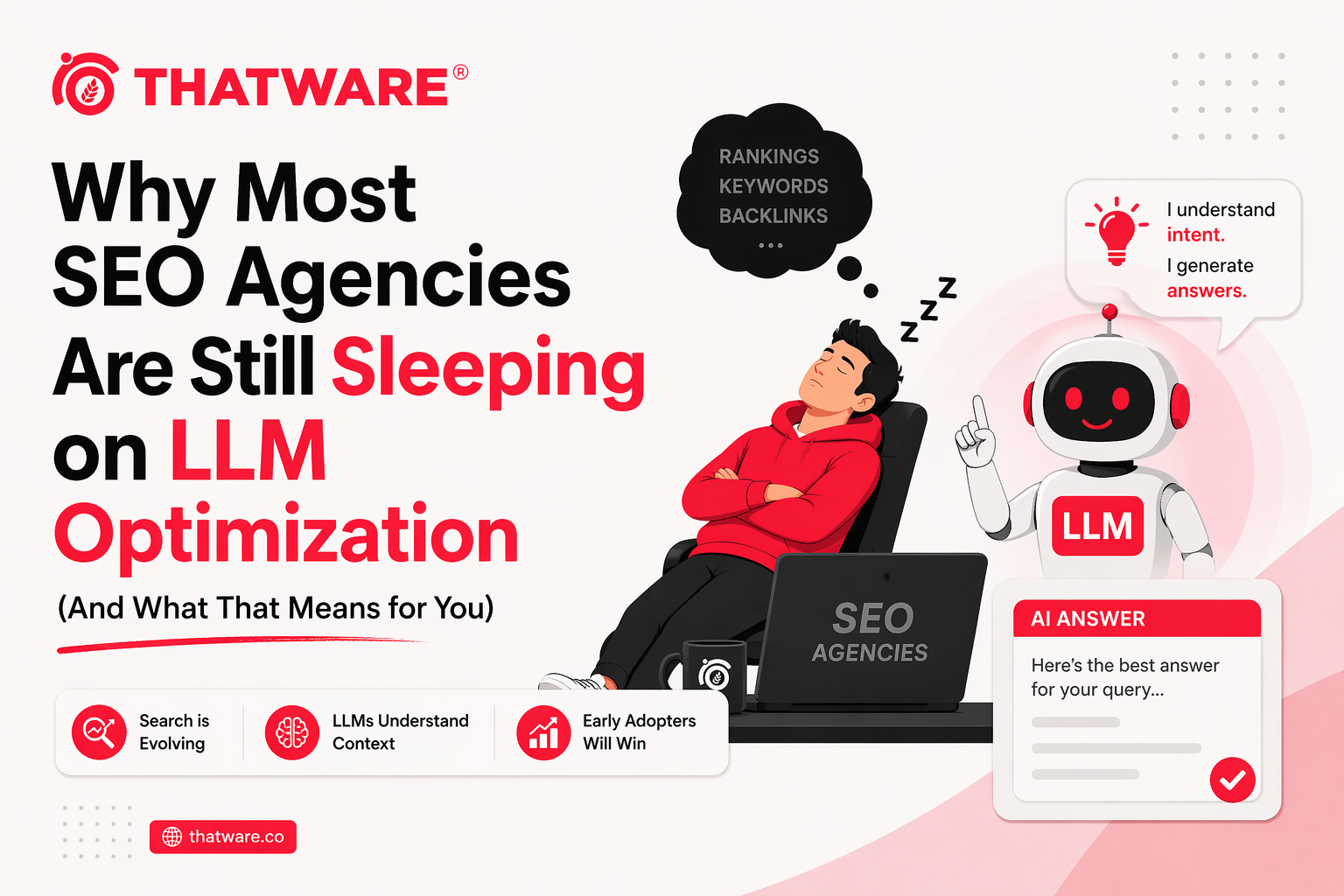
There’s a weird thing happening in the SEO world right now. A lot of agencies — some of them genuinely good at what they do — are still optimizing like it’s 2021. They’re building backlinks, tweaking meta descriptions, obsessing over Core Web Vitals, and doing all the things that used to move the needle. And honestly? Some of that still matters. But there’s a massive shift happening underneath all of it, and most of them haven’t really woken up to it yet.
We’re talking about large language models. ChatGPT, Perplexity, Google’s AI Overviews, Claude, Gemini — these aren’t just novelty tools anymore. They’re becoming the first point of contact between someone with a question and whatever answer they’re going to trust. And if your brand, your content, your website isn’t being surfaced or cited by these systems? You’re losing ground in a way that traditional ranking reports won’t even show you.
The Old Playbook Is Running Out of Road
Here’s something that doesn’t get said enough: Google’s own search results page looks fundamentally different than it did three years ago. The top of the page is often an AI-generated summary now. Users get their answer, maybe skim a source or two, and bounce. Click-through rates on organic results have dropped across dozens of verticals — and that’s not going to reverse.
Most agencies are still measured on keyword rankings and domain authority. Those metrics aren’t worthless, but they’re increasingly incomplete. It’s like measuring a restaurant’s success entirely by how many people walk past it — without checking how many actually walk in and order something.
The agencies that are thriving right now? They’ve started to think about how language models consume and reproduce information. Not just how search crawlers index it. That’s a genuinely different skill set, and the truth is, most SEO shops don’t have it yet.
What LLM Optimization Actually Means
Let’s be real — “LLM optimization” sounds a little abstract. So let me break down what it actually involves in practice.
When a large language model is trained (or retrieval-augmented with live data), it ingests massive amounts of text. It learns to associate certain entities, topics, and sources with authority and relevance. If your content is consistently structured, factually grounded, written in a way that’s easy for a model to parse and summarize — it’s more likely to be drawn upon when someone asks a related question. That’s not magic. It’s information architecture meeting modern AI behavior.
This is where llm seo services come in. Legitimate providers in this space aren’t just slapping new labels on old tactics. They’re doing things like optimizing content for entity clarity, structuring information so it’s easily extractable, ensuring your brand appears in authoritative contexts across the web, and building the kind of topical authority that language models actually pick up on. It’s technical, it’s nuanced, and it requires understanding how these models actually work — not just guessing.
Why So Many Agencies Are Behind
Part of the reason the industry is slow here is simple: there’s no clean metric for it. You can’t log into Google Search Console and see “LLM Citation Score.” There’s no dashboard that tells you whether Claude or Perplexity is pulling from your content when someone asks a question in your niche.
That ambiguity makes it easy to deprioritize. Agencies have clients asking about Page 1 rankings, not about AI model citations. The incentive structure is still pointing at legacy metrics.
There’s also a knowledge gap. LLM optimization draws on linguistics, machine learning basics, content strategy, and technical SEO all at once. Most agencies are deep specialists in one or two of those areas. Very few have the cross-disciplinary fluency to do it well.
And then there’s the fear factor. Admitting that the landscape has fundamentally changed is, in a way, admitting that some of what you’ve been selling needs to evolve. That’s a hard conversation to have with long-term clients.
What This Means for Businesses Right Now
If you’re a business owner or a marketing lead reading this, here’s the practical takeaway: the gap between businesses that adapt to this shift and those that don’t is going to widen quickly. It already is.
Think about it from a user behavior angle. A person looking for a software solution, a healthcare provider, a financial service — increasingly they’re typing that question into an AI interface and trusting what comes back. If your competitors are being cited and you’re not, the damage isn’t always visible in your analytics right away. But it compounds. Brand awareness, share of voice, top-of-funnel trust — all of it erodes quietly.
Working with a specialized llm seo agency isn’t about chasing a trend. It’s about making sure your business is legible to the systems that are rapidly becoming the gatekeepers of information. That’s not hype. That’s just paying attention to where user behavior is going.
The Signals That Actually Matter to Language Models
One thing worth understanding: language models don’t rank websites. They don’t care about your domain authority in the traditional sense. What they do care about — or more precisely, what they’re more likely to draw from — is clarity, credibility, and consistency of information.
Is your brand clearly associated with a specific topic area across multiple credible sources? Is your content written in a way that’s factually coherent and easy to extract meaning from? Are the claims you make verifiable and grounded? Do other trusted sources echo or reference what you’re saying?
These are the signals that matter in an LLM-influenced landscape. And building them requires a different approach than traditional SEO — one that’s more about information quality and entity relationships than anchor text and backlink velocity.
A Few Things Worth Doing Right Now
You don’t have to overhaul everything overnight. But there are a few moves that make sense regardless of where the landscape goes:
Audit your existing content for entity clarity. Does each page clearly establish who you are, what you do, and why it matters — in plain, unambiguous language? A lot of content is written for humans skimming a page, not for systems trying to extract meaning. Those aren’t always the same thing.
Think about your knowledge graph footprint. Are you cited on Wikipedia, in industry publications, in credible directories? Not for the backlink value — but because that distributed presence across trusted sources is how language models build a picture of your authority.
Stop treating FAQ sections as afterthoughts. Structured question-and-answer content is exactly the kind of material that gets surfaced by AI systems. If you’re not producing it intentionally, you’re leaving an easy win on the table.
Wrapping Up — Sort Of
There’s no tidy conclusion here, honestly. The landscape is still shifting. New model behaviors, new search integrations, new ways users are getting information — it’s all moving fast. But the agencies and businesses that are paying attention right now, that are investing in understanding how LLMs interact with their content, are building a real advantage.
The ones still running purely traditional SEO playbooks without a second thought? They’re going to have a harder conversation with their clients in a year or two.
The good news is that the fundamentals of quality — clear writing, genuine expertise, credible information — transfer well into this new world. You don’t have to abandon everything. You just have to understand the new layer on top of it.
That layer is worth understanding. Sooner rather than later.